The pieces in this section will help you to develop skills in the following areas:
1. Regular tempo
2. Independence
3. An awareness of your rhythmic relationship with the music you're playing. An ability to keep a regular, even tempo is very important, and is central to all the pieces in this section. This should lead to the development of a strong internal 'timeclock'; this is the ability to hold a tempo independently without being put off by anything else that's going on. Independence is important in a group situation, because no-one should have to rely on the drummer (or anyone else) to keep the time for them! People should be able to play what they want to play, without the fear of confusing others in the group. This assumes of course, that everybody knows what they are doing rhythmically. If you don't understand what you are doing rhythmically, how can you expect anyone else to? Creative freedom is possible only when musicians are fully aware of their rhythmic place, and what they are doing in relation to the rest of the group.
The two basic elements of rhythm are 'beats' and 'spaces' (silences). The smallest, most basic rhythmic unit consists of: BEAT SPACE BEAT One beat on its own is not a rhythmic unit, because it does not produce a pulse - we cannot distinguish a 'tempo' from it. The length of the space between the two beats determines the 'tempo', which is the speed at which the beats go by. The spaces are therefore as vital to rhythm as the beats are, since only by keeping the spaces between beats constant can you produce an even tempo.
The beats themselves must also be of a consistent length. We call this rhythmic unit (BEAT space BEAT) 'The Fundamental Rhythmic Unit'. Once familiar with this, it can be built on to produce more complex rhythms. The 'One Two' piece isolates the basic rhythmic unit and explores it.
"Before looking at this piece, read the introduction"
This piece confronts the challenge of becoming familiar with the fundamental rhythmic unit (beat space beat). The potential mileage available from experimenting with these two beats is unlimited. When familiar with this basic rhythmic unit, its strong pulse acts as a rhythmic anchor underlying more complex patterns, thus 'rooting' the music.
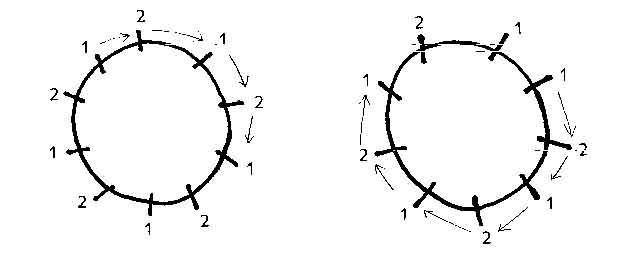
I SEAT the group in a circle so that it's obvious who follows who.
II DECIDE who will start, and which way to go round the circle. The first person begins by saying "One". The person on their left (if the direction is clockwise) then says "Two". The length of space between the One and the Two determines the tempo of the piece, and must be maintained throughout.
III THE first person restates their One while the third person simultaneously comes in with their One, It is up to these two people (and the rest of the group) to recognise and maintain the space (silence) which the second person has left before saying their Two. Thus the pace of the piece remains constant. IV THE fourth person says "Two" (while the second person simultaneously repeats their Two) at the determined tempo, and so on until everyone in the group has joined in. Once people have entered, they must continue to restate their numbers on the appropriate beat.
V AT this stage the group will be split into half Ones and half Twos (unless there's an odd number in the group, in which case the last person and the first person will both be Ones). Everyone will be on either a One or a Two, and there should be an even pulse of "One"... "Two"..."One"... "Two"... Check Speeding up - try to maintain an even tempo. Projection - Be positive when saying the Ones and Twos. Everyone in the group should be easily audible.
STAGE 2
CHANGING BEATS
This is the crux of the piece - exploring the rhythmic permutations that arise from jumping from one beat to another. We practise this by going from One to Two, or Two to One (depending on which beat you started on). This is an individual exercise: there are no rules governing when you should change from one beat to the other.
I START the piece in the same way as in Stage 1.
II ONCE the whole group has entered, everyone is free to start moving from their beat to the other. When changing, jump directly to the next beat. NOTE: the spoken numbers are underlined)
| 1 | 2 | 1 | 2 | 1 | 2 | 1 | 2 | NOT | 1 | 2 | 1 | 2 | 1 | 2 | 1 | 2 |
Stay on the beat you've jumped to for a while in order to see what it feels like and to prepare yourself for making the reverse jump.
III GRADUALLY make the jumps from one beat to the other more frequently:
| 1 | 2 | 1 | 2 | 1 | 2 | 1 | 2 | 1 | 2 | 1 | 2 | etc |
THE quickest way to jump from a One to a Two and back again for vice versa) Is:
| 1 | 2 | 1 | 2 | 1 | 2 | OR | 1 | 2 | 1 | 2 | 1 | 2 |
Practice these patterns until familiar with them. Any quicker changes result in:
| 1 | 2 | 1 | 2 | 1 | 2 |
which is no challenge.
CHECK
An aid to keeping your place is to call one of your feet a One and the other a Two and to tap them in time with the group's pulse. This gives a continual reference point throughout the piece. However, dispense with this aid as soon as possible, and try to rely on your aural sight alone.
This is an exercise in independence. It is very tempting to feel obliged to change when you hear other people changing their beats. Don't let them put you off.
Obviously, you should never hear a One and a Two simultaneously. You should always be stating either a One or a Two on the appropriate beat.
When first approaching this stage of the piece, here is an analogy which may help: there are two mountains, the 'One Mountain' and the 'Two Mountain' You are on one of the mountain tops. While you are on the mountain you must always state its number in the appropriate place (on the appropriate beat). Jumping from the 'One Mountain' and landing on the 'Two Mountain' is equivalent to changing from the One beat to the Two beat. The stating of the numbers is equivalent to jumping or landing.
In order to jump from one mountain to the other you must start from one (state its number) and jump straight to the other. When you are landing you must always say the number of the mountain that you have landed on (the beat that you have changed to).
You cannot stay in the air while you decide where to land or you'll fall down into the valley. In the same way, you cannot wait without restating your number while several beats go past, whilst deciding where to land (see Stage 2 point II).
When you jump back again you must restate the number of the mountain that you are on before you can return to the other. You cannot bounce from one mountain to the other and straight back again because the mountains are not trampolines nor made of rubber. In the same way, you cannot say "One... Two... One... Two" - see Stage 2 point IV.
Changing Beats in Pairs
Once the group has become relatively fluent in swapping from one beat to the other and back again, divide the group into pairs and repeat the process. The method is exactly the same as in the group format (see stage 2).
Since there are only two people involved, there will be times when they will both be on the same number, leaving a gap where the other number would normally be stated. This feel s a bit precarious at first, but with practice is easily accomplished, and can become a pleasure. Make sure you always maintain an even tempo.
INTRODUCING HANDCLAPS
By now everyone should be familiar with swapping from one beat to the other and back again. This next development is to introduce a handclap halfway between the One and the Two - in other words, on the halfway beats.
I THE piece is started in the same way as before, except that the first person says "One" and then claps. Since this clap is halfway between the One and the Two, the first person is now determining the tempo.
II THE rest of the group enters as before but everyone claps after the number they have stated:
| 1st person | "one" | clap | "one" | clap | |||
| 2nd person | "two" | clap | |||||
| 3rd person | "one" | clap | etc... |
III ONCE the whole group has entered, everyone tries swapping from their beat to the other and back again as before. Remember that the handclaps come only after the stated beats.
IV THE quickest you can jump from your number and back again becomes: (NOTE: the underlined figures represent the spoken beats, and the underlined asterisks represent the hand claps on the halfway beat)
| 1 | * | 2 | * | 1 | * | 2 | * | 1 | * | 2 | OR | 1 | * | 2 | * | 1 | * | 2 | * | 1 | * | 2 | * |
CHECK
Forgetting to clap after the number you've jumped to.
Clapping at the same time as you say the number.
Clapping on both halfway beats, rather than after the stated beat only.
PRACTISING ONE TWO AS AN INDIVIDUAL
This can be used to show how to change beats when demonstrating Stage 2 to a group, USE your voice to state the One (which you start on), and a stamp of the foot to indicate where the Two falls. Thus the Two is always stated, (Note: underlined numbers indicate stated beats, ie voice; F indicates a stamp of the foot)
| PULSE: | 1 | 2 | 1 | 2 | 1 | 2 | 1 | 2 | 1 | 2 |
| F | F | F | F | F |
You can swap back and forth between beats, as you would with a partner,
II YOU can also incorporate handclaps (halfway beats) to mark the halfway point between beats, (NOTE: halfway point = *; Handclap = *)
| PULSE: | 1 | * | 2 | * | 1 | * | 2 | * | 1 | * | 2 | * |
| F | F | F |
Once everyone has become very familiar with the piece using voices and clapping, it can be transferred onto instruments. Let people select three pitches or sounds on their instruments - a low register pitch, a high register pitch and one in between. Instead of saying the numbers out loud we can use these pitches as our reference to where the Ones and Twos are lying, by making the low pitch a One and the high pitch a Two (or vice versa) The one in between then becomes the halfway mark, or hand clap.
I THE piece is performed in exactly the same way as before using instruments instead of voices and handclaps. Start off with just the pitches for One and Two.
II As people become more fluent at swapping from one to the other, the halfway pitches can be introduced (as in Stage 3). Continue to swap beats, incorporating the halfway marks.
CHECK
As we're now dealing with pitches and not spoken numbers, it is much easier to confuse the Ones for Twos and vice versa, Don't rush into putting in the halfway marks before really exploring and becoming strong on the basic One Two. Keep the notes short and precise so that their rhythmic spacing is obvious.