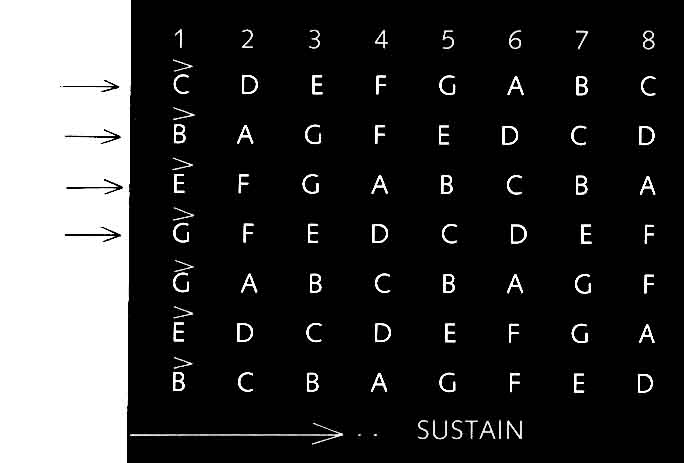
'Dissonance' is a positive harmonic element. In both 'Oddseven' and '1 2 1 3' we explore the harmonic permutations available from a simple scale. In 'Oddseven' we use the scale of C major, since it is the first scale that many instrumentalists learn.
The various combinations of notes in any scale present extensive harmonic possibilities. In 'Oddseven' and '1 2 1 3' we look at scales not merely as vehicles for practising but as positively attractive melodies in themselves. To perform these pieces you must play a tuned instrument or sing - drummers and non-tuned percussionists cannot participate except to act as a rhythmic accompaniment. Every person performing the piece will play the same series of notes, each starting their cycle in different rhythmic places. This calls for discipline and concentration in both counting (independence) and intonation.
Transposing instruments: Horn players whose instruments are not in concert C will have to transpose. In 'Oddseven' all B flat instruments (tenor and soprano saxes, trumpet etc) will play their scale of D major (concert C major), and E flat instruments (alto sax etc) will play their scale of A major. In order to exhaust all the possible combinations of notes, it is necessary to have 14 people (2 groups of 7) to perform 'Oddseven' and 26 people (2 groups of 13) to perform '1 2 1 3'. However, both pieces can be profitably played with fewer people - if there are more people, some parts will be doubled up.
METHOD
I BEGIN by making sure that everyone is in tune with each other. If there are pianists in the group it will be necessary for everyone else to tune up (or down) to the piano.
II THE sequence which everyone will be playing (in different rhythmic places) is the scale of C major, played up and down, not repeating either the top or the bottom C. It is played in groups of eight beats, accenting or stressing the first beat of each measure of eight. Practise this together as a group.
It takes seven full cycles to arrive back with the accent(first beat of the measure) on the C.
III MAKE sure the accented notes are stressed really strongly. The rest of the cycle should be played smoothly with little or no attack on the notes.
IV WHEN the group has gone through the sequence a few times, arrange people in a circle, so that it's obvious who follows whom. If there are more than seven people, divide them into groups of seven, or one group of seven and another group of the remainder.
GROUP1 ENTRIES
I THE first person of the group enters playing the sequence. As they begin their second measure of 8 beats (they will be stressing the B of their descending scale), the second person enters with their first cycle on their ascending scale.
II AS the second person begins their descending scale (as they stress the B on their 9th beat), the third person enters with their first ascending scale. In other words, each person enters 8 beats after the person before them has entered.
III CARRY on entering in this way until everyone in the first group is in. When each individual has completed 7 cycles, they sustain the last note of their seventh cycle (D).
IV THE length of the sustained note (D) at the end of each person's 7th cycle may be left to each person's discretion. They may either sustain it for eight beats, or for their breath length. After finishing their sustained note, they must wait their turn to re-enter.
RE-ENTRIES
V WHEN the seventh person has completed their sequence of 7 cycles, like everyone else, they sustain their D. They will be playing their last cycle on their own at this stage (apart from any lingering sustained Ds). The first person should listen for this final cycle, and repeat their 7 cycles as before, starting one beat after the seventh person lands on their D, ie beat 1 of the 14th measure of 8 beats.
VI THE second person re-enters as before, on the first second measure of 8. The first person will be accenting the B of their descending scale.
VII THE whole group re-enters exactly as before. 8 beats after the person preceding them has started.
This process accents the 1st, 3rd, 5th and 7th notes of the scale (C, E, G, B). In order to get accents on the rest of the notes in the scale (D, F and A) you can introduce a second group. To get the full effect, you need seven people in this group, but it can be done with fewer. If there are more, some parts will be doubled.
GROUP 2 ENTRIES
THE second group plays exactly the same sequence as the first group, but in a different rhythmic place. After the first group has completed their first whole sequence (13 complete measures of 8), the first person of group 1 is ready to re-enter. The first person of the second group enters with their sequence on the second beat of the 14th measure of 8. That is, they enter one beat after the first person of the first group's re-entry.
| 1 | 2 | 3 | 4 | 5 | 6 | 7 | 8 | |
| PERSON 1: GROUP 1 | C | D | E | F | G | A | B | C |
| PERSON 1: GROUP 2 | C | D | E | F | G | A | B |
The first person of the second group will be playing an accented C while the first person of the first group is playing a D.
THE second group enters in turn in exactly the same way as the first group does (see points V and VI), that is, 8 beats after the person before them has entered. It is very important to stress the accents strongly at this stage. There will be an overall effect of two accents (one after the other) every 8 beats - the first accent comes from group 1, the second from group 2.