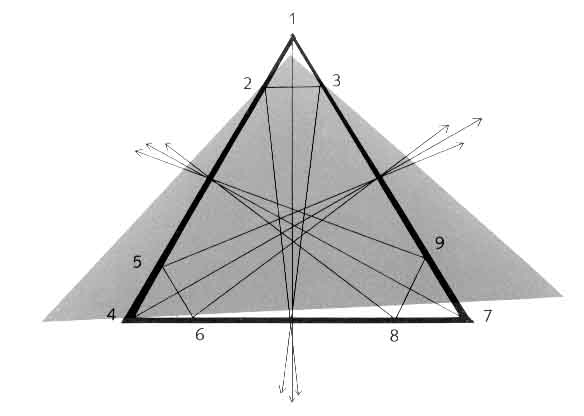
This piece is about developing your listening skills, whilst at the same time encouraging an unselfconscious attitude towards your own playing. It may also help you to discover a free and relaxed (perhaps unconventional) way of playing your instrument. The process of the piece should lead towards a balanced and meaningful free group improvisation.
STAGE 1
I SEAT 3 people in an equilateral triangle. Each person focuses their attention on the space between the two others, as if they were listening to the two speakers of a stereo system.
II AS soon as one person begins to play, the other two immediately join in -the effect being as if the trio had started at the same time.
III EACH player should use their instrument as a sound source for the other two players to listen to.
IV THINK of a 'scribbling' sound rather than patterns or sustained notes - find a comfortable way of playing which doesn't need thinking about. It is fine, for example, just to rub your hands along the strings of your guitar or bass, or to breathe down a wind instrument, as long as you can be heard by the other two people in the triangle. Once you have found an appropriate sound level, keep it.
V EACH person must 'scribble' continuously,. with no unnecessary gaps in the sound. This ensures that each member of the Triangle is always audible to the others.
VI AT this stage, each person should be listening only to the other two members of the triangle. Be as detached as possible from what you are playing, focusing only on the other two players.
STAGE 2
I GRADUALLY allow yourself to become aware of your own sound within the triangle, so that you can now hear the three parts equally.
II DO NOT change the way in which you are playing as a result of this.
III IF you do find that you change the way you play when you start listening to yourself, go back to Stage 1 (see point VI). It is not necessary for the whole Triangle to stop and go back to the beginning - just change your own approach.
STAGE 3
I AT this stage the players can begin to make musical choices: interaction begins, improvisation now takes place.
II MAINTAINING the balance of the trio and playing into the overall sound of the triangle should be the main aim at this stage, always bearing in mind the process which - the group has been through.
III THE piece ends as soon as one person stops - as at the beginning, it should sound simultaneous.
CHECK
Balance: if any player cannot hear the whole triangle, they must: feel free to stop and adjust the sound balance. This is vitally important at any stage. Never get so immersed in your own playing that you cannot hear the other two equally, or the internal balance of the trio will be lost.
Act primarily as a sound source, not a source of specific melodies and rhythms. Find a way of playing that doesn't need thinking about, avoiding cliches or 'licks' learnt off by heart. Bypass the mind as much as possible and let your ears do the work. Closing your eyes is vital. This is an aural exercise
Extension of Triangle
It is possible to play this piece with nine people, forming three separate triangles.
I THE piece starts as for a simple triangle. As soon as anyone starts, everyone starts.
II EACH triangle follows the same procedure as for one triangle, through the first and second stages.
III AFTER you have listened to your own triangle as a whole (stage 2) stop listening to your triangle and throw your attention out to incorporate the other two triangles, so that you have the stereo effect from the two groups instead of from two people.
IV NOW incorporate the sound of your own triangle into the overall sound.
V AT this point you are ready to make your first steps towards a free group improvisation. Be aware of the fact that people will be arriving at this point at different times. Don't drastically change the way in which you have been playing.
VI WHEN any person in any group stops, all stop.