"It is vital that the workshop members are not aware of the true aim of the procedure at stage 7, points I-IV, as this would limit the freedom of their improvisation *
This piece uses and explores musical motifs or phrases which the workshop members invent for themselves. These phrases are arrived at by asking everybody to improvise freely in turn. They are then incorporated into a more complex composition. The result is a group composition.
STAGE 1
I TAKE each workshop member out of the room, one at a time. Ask them to improvise freely when you clap your hands. When you clap again, they must stop playing.
II IF they play familiar passages or phrases (not improvising freely), tell them to aim for speed on the instrument.
III WHEN they are playing freely in a speedy and unselfconscious way repeat the process, leaving a fairly long gap between the claps.
IV TRY to isolate a single phrase by clapping twice in quick succession and ask the person to repeat that phrase. You may be able to help them with it if they can't remember it. if neither of you can remember it accurately then get as close as you can (you must be listening attentively while they are playing).
V WHEN a phrase has been isolated successfully, the player must remember it and practise it. It must be placed in a rhythmic context to establish where it lies in relation to the beat (before the beat, after the beat, in between the beats or on the beat).
VI IF there is no space to practise without the rest of the group hearing (which could influence their improvisations) people must keep their motifs in their heads until everyone has isolated their phrase.
VII AFTER everyone has practised their phrases individually, set up a beat of '1 2 1 2' and ask each member of the group to play their motifs in turn, leaving a count of '1 2' between each person. This accomplishes two things firstly, each individual practises rhythmic precision (coming in with their motif in exactly the right place). Secondly, each person becomes familiar with everyone else's phrases.
STAGE 2
I NOW the group has heard each phrase separately. The next step is for the group to play their motifs simultaneously to form a cluster. Set a beat of '1 2 1 2' and everyone must come in with their phrase.
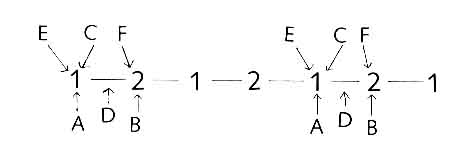
II THE aim here is, while keeping the cluster of phrases concentrated, to get as much separation between the individual phrases as possible. It may be necessary to change where some of the phrases lie in relation to the beat. For example if there are six people in the group, two people (A E B) may have motifs which they have placed starting on the beat, one person (C) starts their phrase after the beat, one person starts their phrase between beats (D), and two people begin their motifs before the beat (E & Fl. In this case you could get:
III EXPERIMENT with the rhythmic placing of the motifs- this is another aspect of composition which the whole group can take part in. If there are several people starting, for example, on the beat, it may be better to move some of their phrases to start between beats and so on. This is a difficult thing to do (to change where your phrase lies in the rhythmic context) take as much time as you need to get it right.
IV WHEN the cluster has been decided on, the group should repeat it in time, leaving gaps of two beats in between each cluster.
V WHEN this has been consolidated, each individual should then experiment with repeating their motif (over a beat of '1 2'] leaving a gap which seems natural to them between phrases. For example, one person may feel that the gap which lies between their repeated phrase should be 2 beats long, whereas another person with a similar phrase may find a gap of 1 beat more natural and comfortable.
VI THE group could now let this develop into a group improvisation, with each person embellishing their phrase whilst retaining their rhythmic place.
VII ALTERNATIVELY, this could be formalised by arranging it as a performance piece. For example, you could begin with 8 measures (counts of '1 2') of repeated clusters (point 1V), 8 measures of repeated phrases (point V), 32 measures of embellished motifs (improvisation), and finish with 4 measures of repeated phrases.
STAGE 3
I LINK the phrases together so that there are no gaps between them. This means that most of the melodies will fall in a different rhythmic place from that arrived at in point VI. This may take some time, as the 'feel' of the phrases will change.
II BY linking the phrases in this way, a longer rhythmic melody line is created, which is 'linear' - that is, only one person at a time is playing (as opposed to the 'clusters' at stage 2). Again, the group can arrange this as a piece or suite. For instance, this could involve playing the line, and establishing how many measures long it is, and then soloing or duetting over the length of the line. Discuss possible arrangements with the group.
CHECK
In Stage 2 of the piece, because of the nature of the interwoven 'rhythmelodic' motifs (the phrases which the members of the group have invented for themselves in which the rhythm and melody are equally significant), often the effect implies African or Latin rhythms. This stage can be accompanied by a rhythm section playing accordingly. The linear rhythmelodic line (Stage 3) often implies a jazz or rock feel, since it's closer to a conventional melody line. A suggestion for arranging the piece is to use fragments of the motifs as riffs to break up the solos.
Another arrangement technique which can sound very effective is to sustain the notes of some of the phrases (as in the 'Happy Birthday' piece) as a backing for solos. This piece can be demanding for some people as it involves playing specific pitches and rhythms, even though they were originally invented by the players themselves. Take as much time as necessary to get it right.
See CREATIVE INDIVIDUAL PRACTISE METHOD.