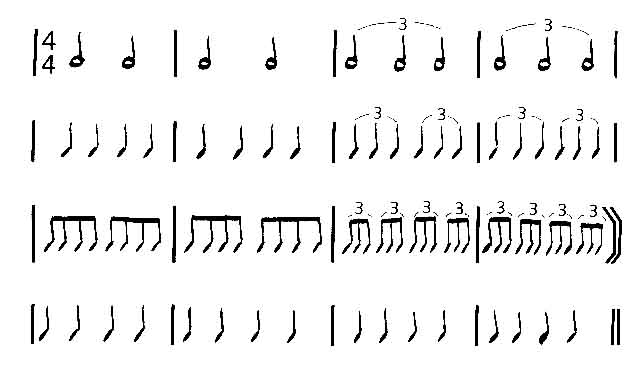
Select a number of bars for the length of the piece. After a count in of '1 2 3 4' at an easy walking pace, everyone begins to walk (or run) at a different level of the Rhythm Tree - in the same way as a music group would play the slow two, the slow three, the four and so on, a dance group moves at these different paces. Each person moves at a pace which is related to the tempo given in the initial count-in. The piece can end by everyone walking off after the prearranged number of bars, all moving at the same tempo (we recommend the easy walking pace of the count-in).
Another possible development of the piece is for each individual to move through the different levels of the Rhythm Tree. For example, if the group decides to use the first six levels of the tree, and to take two bars at each level, the piece will take twelve bars for each person to complete the cycle.
'THOROUGH FARE' - (Rhythm Tree )
Many of the pieces in this manual can be adjusted for use in dance or drama groups, either as pieces for improvisation, as preparation exercises. Here are some ways in which the pieces could be used:
Each person begins the piece at a different level of the Tree and moves upwards after repeating that pace over two bars. For instance, if someone starts on the 6, they move to the 8, the 12, then down to the slow 2 then the 3 and the 4 (where they stay for the ending). The person who starts on the 12 obviously has to move down to the slow 2 next, before they start moving up the Tree. Each person experiences each level of the Tree twice. After the 12 bars have elapsed, everyone goes to the 4 (the easy walking pace) and synchronises there. There are many other ways in which the group could develop this piece - for example, to count in and end the piece at the pace of the slow 3, and relate all the other rhythms to that.
Here are two possible ways in which this piece can be adapted. a) If there were six people in the group, all six have the same movement for the accented 'one', and individuals compose movements for each of the other five beats. Each person, in selecting their own movements, should keep them fairly simple, so that while they are performing them, it is possible to observe and identify the activities of the rest of the group. The movement for the accented One should be dynamic and obvious, so that it can easily be seen going around the group. The improvisation develops out of the movements which people have already chosen, and relating to the rest of the group. The accented One should be maintained throughout. The piece can end by each person performing only the One, and remaining still for the rest of the five beats b) The group selects together the movements for the whole cycle of beats so that everybody performs the same movements one beat apart. The improvisation develops out of this cycle.
Go through the same procedure as detailed for a music workshop. Begin from stillness (the equivalent of group silence), and each person, in their own time, starts the procedure. Breathe in as deeply as possible, remaining static, and exhale as slowly as possible. Accompany the exhale with scribbling movements - these should not distract from the controlled slow breath out.
The movements are almost subconscious and secondary to the breathing. When the cycle is comfortable, each person can begin to relate to their environment, and to allow the observation of the movements around them to influence the nature of their scribbling. This leads to a free group improvisation in dance, where more normal breathing naturally begins to take place. The piece can end by going back to the initial scribbling and slow breathing, allowing the scribbling to gradually diminish, until only the cycle of breath remains in stillness .
Similarly, in a drama group, substitute words for movements, and follow the same procedure towards a free group improvisation using words. Word scribbling is similar to a rapid stream of consciousness. The following piece 'Immediate Past Is Present' can be used as a piece in its own right, but is also useful in developing the rapid use of words related to slow breathing.
IMMEDIATE PAST IS PRESENT
IMMEDIATE PAST IS PRESENT
OUR PRESENT IS AFFECTED
BY OUR IMMEDIATE PAST
OUR PRESENT IS ALSO AFFECTED
BY THE IMMEDIATE PAST
OF PERSON OR PERSONS
HELPING TO MAKE UP
OUR PRESENT ENVIRONMENT
OUR PRESENT IMMEDIATE PAST
IS AFFECTED BY ITS IMMEDIATE PAST
AND IN TURN AFFECTED BY THE IMMEDIATE PAST
OF PERSON OR PERSONS
HELPING TO MAKE UP OUR
IMMEDIATE PASTS'
IMMEDIATE PASTS'
ENVIRONMENT.
Breathe in as deeply as possible and try to say all the words in one breath. Having achieved this, go back to the top of the piece, and see how much of the set of words can be repeated within the one breath. Everyone's breath length differs, and so everyone will finish in different places. The rapid rhythms of the words, and the different places where the words end will stress varying rhythms and meanings. Improvisation takes place within this word vehicle, using the breathing technique to open up the initial possibilities .
'NAVE' (Evan P) - ('Beckett')
This piece functions in a similar way to 'Beckett' and '2 Albert' except that the breath is held for as long as possible. Playing, singing, speaking or movement takes place on the dynamic exhale.
Select a short word and say it in as clipped a way as possible. Follow the stages using words instead of sounds on a musical instrument or voice. The same procedures can be followed using movements.
Any of these pieces can coexist with the equivalent music. The transition between everyday movements and dance takes place when the movements are conceived of as being the beginning of dance. Similarly, our conversational dialogue becomes poetry or singing when it is conceived of as such. If your interest lies within the visual arts (painting, sculpture etc) it is hoped that this manual will help to open up fields for exploration.