Do not attempt this piece until well versed in the ONE TWO and ONE TWO THREE FOUR pieces
Introduction
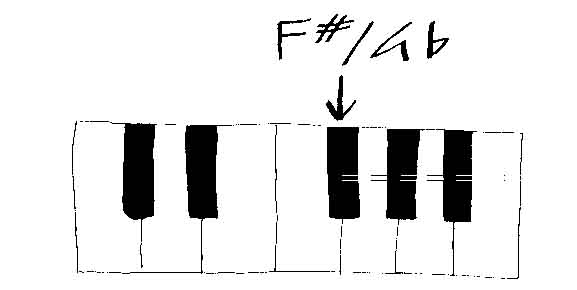
Western music has been based, for some two hundred years now, on a system of 'equal temperament', This consists of dividing the octave into twelve equal units, called semitones. These can be seen as the twelve keys per octave on the piano, and the corresponding twelve frets per octave on the guitar. This system means, for example, that you play the same key or fret for the two notes F sharp and G flat:
In the music of other cultures, different systems are often used. In Indian music, for example, the octave is divided (for practical purposes) into 22 units, called shrutis. These are thought of as modifications to seven basic notes, called svars. These svars are the same notes as the seven tones in a western major scale. The shrutis are thought of as being 'natural' (an unmodified svar,) 'flat', 'extremely flat', 'sharp' and 'extremely sharp'
In this piece we explore a similar concept. It works on the premise that F sharp (as a 'raised' F natural) is higher in pitch than G flat, which is thought of as a 'lowered' G natural. Whilst it is impractical to explore these differences on a piano, where F sharp and G flat are combined in one key, it is quite possible to explore them on any instrument which has scope for 'bending' or altering notes in any way. On an unfretted instrument leg bass, violin) it is easy to see that there are several pitches, or microtones, lying between the semitones of the equally tempered piano keyboard:
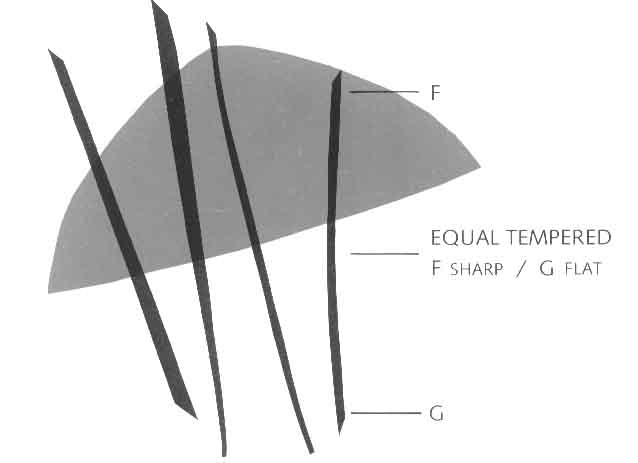
When playing this piece, we will be familiarising ourselves with the following different pitches: (starting from the lowest) F, G flat, F sharp, and G. We will also try to find the notes halfway between F and F sharp, and G and G flat.
The procedure of 'Microtones' is very similar to that of 'One Two'. In order to play it, therefore, the group should be familiar and confident with the One Two piece, up to and including Stage 3 (introducing handclaps). The piece is divided into three sections, each of which can be worked on separately, and then played together, with different people playing each section simultaneously. The important thing is to experience the magnification and splitting of the semitone (the smallest interval on a piano keyboard). Players whose instruments offer no scope for 'bending' or altering the notes, and percussionists can accompany the others with the One Two piece.
I FOLLOW the same procedure as for 'One Two': form a circle and go around it, splitting the group into Ones and Twos. However, instead of using the numbers, designate specific pitches for each beat - in this case, F for the One and F sharp for the Two. At this stage, don't worry about the difference between the piano's F sharp and a 'true' F sharp (see introduction).
II ONCE everybody is 'in' (playing an F or an F sharp], they can practise swapping from one note to the other on the appropriate beat. For the purpose of rhythmic accuracy keep the notes short to begin with.
III WHEN the group is comfortable with this, begin to sustain the notes for the complete value of the beat.
IV NOW try to 'glissando' (slide) the notes into each other, sliding upwards from the F to the F sharp (when changing from One to Two), and downwards from F sharp to F (Two to One]. In doing this, you will be playing through the microtones between the two notes.
V WHEN people are ready, the equivalent of 'handclaps' can be introduced between the beats. In this case, the handclap note will be exactly halfway between F and F sharp. If the procedure has been followed correctly, this 'quartertone' will have been passed in the slide between F and F sharp. Time the glissando so that the quartertone is reached exactly halfway between beats.
VI ONCE familiar with the pitch of the quartertone between F and F sharp, stop the sliding between the notes, and play each pitch individually, still keeping the One clap Two clap rhythm going.
VII NOW do steps I to VI again, this time changing the pitches; G is One and C flat is Two.
VIII THIS process (I to VII) can be repeated and practised in pairs, in the same way as in the One Two piece.
I THIS part of the piece is best performed by four people forming two pairs in the same way as for 'Mixed Doubles'. Each person should sit facing their partner.
| PAIR A: |
X
|
<------>
|
X |
| PAIR B: |
X
|
<------>
|
X |
II DECIDE which person in each pair should be the One and the other will be the Two. All the notes played should be sustained for the full value of the beat.
III IN Pair A, the One will be F and the Two an F sharp. Think of the F sharp as leading upwards towards G. This pair uses the F and F sharp in exactly the same way as in Stage I, changing notes on the appropriate beat.
IV THE second pair [Pair B), follows exactly the same procedure as Pair A, only using the other pair of notes for the two beats. In their case the One will be G, and the Two a G flat. Again, think of the G flat as leading downwards towards F.
V THE two pairs swap between their given notes: 1 2
VI WHEN people feel comfortable with the pitching of their notes, they may introduce the halfway beat which becomes the note exactly in the middle between F and F sharp, or G and G flat.
VII THE 'glissando' approach suggested in step IV of Stage 1 will help to find the microtones between any given pitches. Having found the pitch, stop using the glissando, and aim straight for the microtone, still sustaining each note for its full value.
VIII THE procedure is now the same as for One clap Two clap on instruments (Stage 4 Of 'One Two') - it's just that different pitches have been designated for each beat.
IX WHEN ready, the two pairs can swap pitches (ie Pair A uses G and G flat, and Pair uses F and F sharp).
"For four people or more:- this should not be attempted until familiar with ONE TWO THREE FOUR "
I THIS stage can be performed as a separate piece, or alternatively whilst the two pairs of Stage 2 are playing. It is an extension of the One Two Three Four piece and simply involves designation each beat with a pitch:
| BEAT: | ONE | TWO | THREE | FOUR |
| Pitch: | F | F# | G | Gb |
II THE procedure is exactly the same as for the One Two Three Four piece. Each beat has a corresponding pitch. The players move from one beat to another, changing their pitches accordingly. The F sharp (beat 2) leads upwards towards the G (beat 3), while the G flat (beat 4) leads back down to the F on beat 1. Check If stages 2 and 3 are being played at the same time, the players can swap roles when they feel ready.
Opinions may differ as to the exact pitching of some of the notes. The actual search for these notes is more important than a 'perfect' end result. Obviously, revolving the piece around F and G is arbitrary; the piece can be pitched anywhere provided that the notes chosen for the One and Two are a tone apart. For example the group could use C as One and D as Two.
Exploring Microtones further:- so far, the group has only looked at quartertones (halfway pitches between semitones). To take the concept of Microtones further, select pitches which are closer together - rather than the pitches being a semitone apart, select pitches which are only a quartertone apart. For example, rather than using F for beat One and F sharp for beat Two, use F on beat One and the quartertone above F on beat Two.