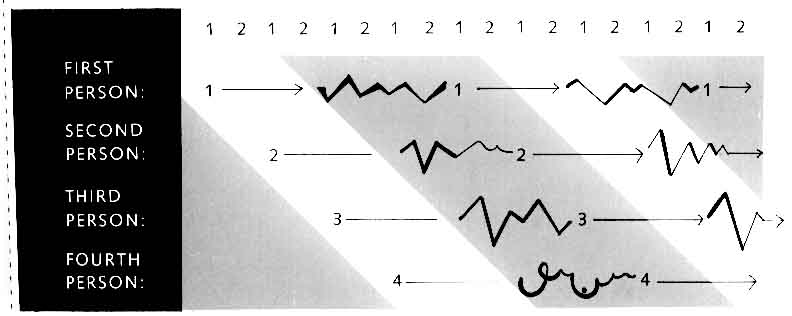
Do not attempt this piece until well versed in the ONE TWO piece
Musicians, when deciding which instrument to play, select an instrument which seems attractive to them. This choice is a very personal one, and in a sense, the instrument which you have chosen to play is an extension of you as an individual, Just as musicians have personal influences, tendencies and characteristics, so too each instrument has its own characteristics. The music made by any one individual, then, is a combination of two elements - the nature of the musician, and the nature of the instrument they have chosen to play. In this piece we ask people to play one sound, from the whole range of sounds available to them, which epitomises (as nearly as possible) their idea of beauty. That beauty is the result of the collaboration between a musician and their instrument - it is totally subjective and very personal. In the same way as an artist would select one colour from the palette to put on the brush and begin a painting, we ask a musician to select one sound which they find beautiful from the range of sounds available on their instrument - we call this choice a 'soundcolour'
I SIT in a circle.
II EACH person selects one sound on their instrument which they find beautiful. People playing chord instruments should play one note only. The dynamics of each note will vary according to individual choice, as the thickness of a brushstroke would vary naturally.
III Go around the group one by one, playing the notes in turn. Leave a natural gap after the preceding person finishes their note before entering.
IV KEEP going round - people can adjust their notes until everyone is happy with their soundcolour.
V EACH person should now select a length which suits their sound. This is not like 'Sustain Piece' (page 65), where you keep the sound going for as long as possible, or 'Click Piece' (page 63), where you make your shortest sound. Think of the length of the note as a natural gesture with which you present the soundcolour; a natural sweep of the paintbrush to present a colour rather than painstakingly drawing a long line or small dots. On guitar a tremelo could be used to sustain the note if plucking does not produce a long enough sound. A percussionist could do a roll for the same reason. There are no hard and fast rules - at this stage just be practical - both with the length of the notes and the gaps between them.
VI ONCE everyone has settled on a specific length for their sound, practise by going around the group a few times playing them in turn, until all the soundcolours are consistent.
VII PUT the sounds into rhythmic context by placing them over a SLOW beat of 1 2 1 2. Each person plays their soundcolour in turn. either entering on each 1 or entering on each consecutive beat (the first person on 1, second person on 2, etc).
VIII NOW everybody has established precisely how long their soundcolour is, and can play it accurately. The soundcolours will often overlap, as many of them will be more than 2 beats long this produces a group soundcolour.
IX AFTER the last person to play their soundcolour has entered, the first person re-enters in the same way as the rest of the group has already done. Continue in this way.
X WHEN this has settled down, everyone is used to the group sound and can come in accurately with their own soundcolour, people can improvise in the space between the end of their sustained note and the place where they must re-enter with their soundcolour. Allow the group sound of overlapping sound colours to affect your improvisation .
Note: this diagram is showing a possible combination of sound colours - each group will have different lengths and thickness of notes.
POSSIBLE PROBLEMS
If any of the soundcolours are very long, or if it's a small group, people's soundcolours may not have finished when it is time for them to come in again. In this case, either leave more time between entries, for instance, enter every third measure of 1 2, instead of every measure, or slow down the pace of the piece.
Alternatively, if most of the soundcolours are quite short, and there is very little overlapping, either get the group to enter on each consecutive beat (the first on 1, the second on 2, the third on the next 1, etc) or speed up the pace of the piece without shortening the individual soundcolours (so that a note previously lasting 2 beats might now last 4 beats).
A SUGGESTION FOR ARRANGEMENT
This piece can be performed with a rhythm section playing a version of 'One Two' behind it, for example 'Mixed Doubles'.